[01]
CIVIC EMBLEM PROPOSAL | HO CHI MINH CITY
Sài Gòn's landmarks, inside a civic seal.
What happens when an emblem inspired by Sài Gòn's streets has to appear on a direction sign, staff ID, or public notice? This independent civic identity proposal combines historic architecture and bridge imagery in a detailed circular seal. QART paired it with straightforward Vietnamese typography and a blue-and-white graphic system for signage, credentials, and stationery. The project is a visual concept, not an adopted municipal identity.

[02]
The Challenge
A detailed emblem still has to serve the public.
An architectural illustration has room to breathe on a large sign. Reduce it to a staff badge and some of the detail becomes harder to see. Public information has a different job altogether: a room label, staff name, or notice has to be readable without deciphering the emblem. That range of applications shaped the proposal. QART wanted the mark to reflect Sài Gòn's built environment, including heritage architecture and a modern bridge, rather than rely on a generic symbol of government. But the visual character couldn't take over the basic function of a civic sign: helping people identify a place, read a message, or find their way. The project therefore became an exploration of two layers working together, a detailed emblem that carries the sense of place and a restrained graphic system that carries the everyday information.

Sài Gòn Ward wayfinding, in blue and white.
[03]
The Solution
Landmarks in the seal. Clarity around it.
The proposal uses a circular blue emblem with an illustrated urban scene at its center. Historic architecture and bridge imagery appear together, giving the mark a specific connection to the ward. A blue-and-white system surrounds it with straightforward Vietnamese typography, generous white space, and clear alignment. You can see this separation in the wayfinding mockup. The emblem identifies the civic setting; large arrows and labels handle the route to reception, meeting rooms, and facilities. On staff cards, names and roles sit below the seal, not inside its artwork. On letterheads and folders, the mark becomes a quiet institutional signature. The surrounding layout stays simple so the illustrated seal does not compete with the public information. This is intentionally an illustration-led concept. Its character comes from recognizable local imagery rather than a minimal abstract monogram.

A civic seal on staff and visitor IDs.

Signage and badges, one civic identity.
[04]
The Process
From civic signs to staff credentials.
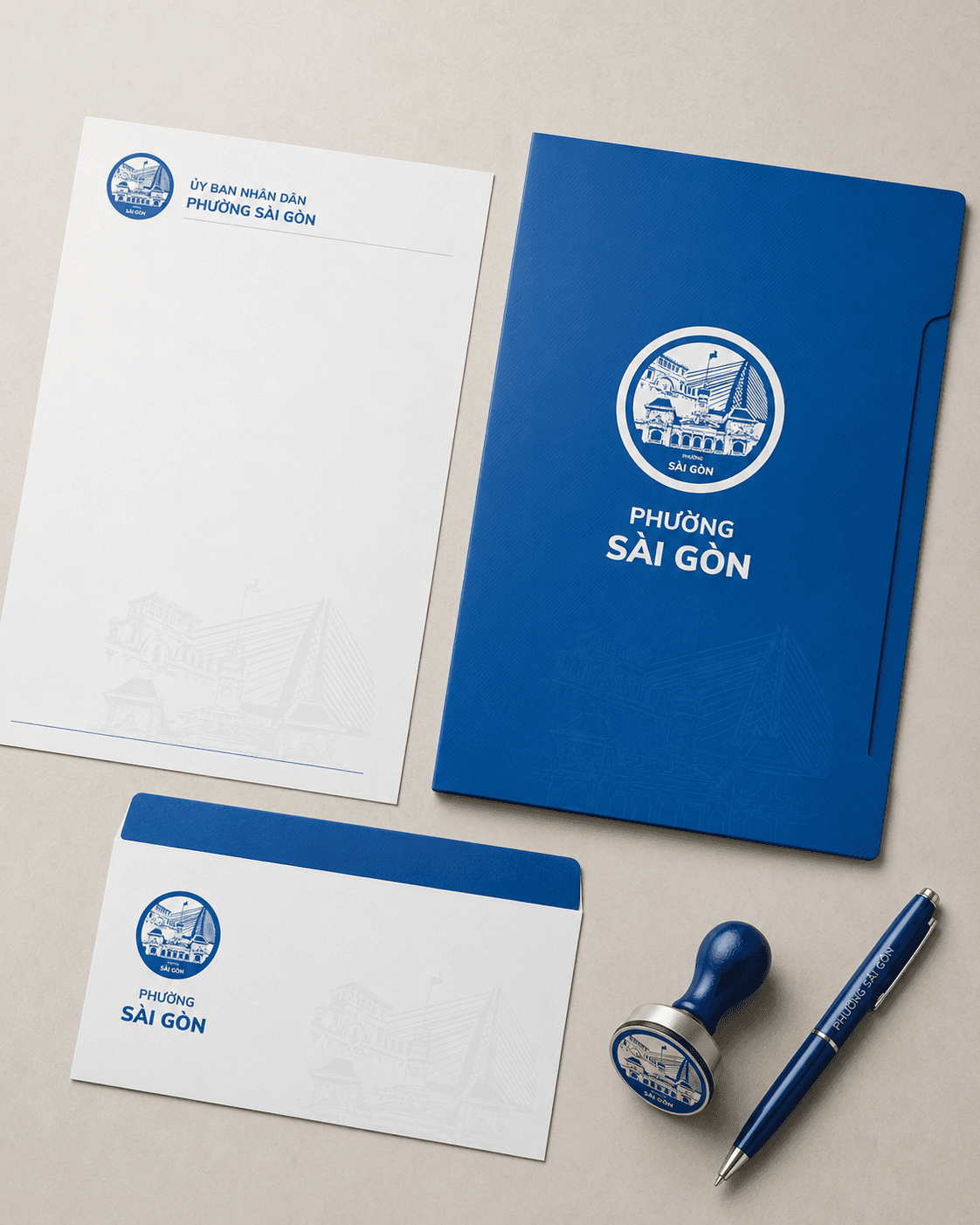
The applications make the design's strengths and limits visible. An exterior sign gives the mark enough scale to show the architectural scene; a badge reveals which details become less prominent when the seal is reduced. The blue-and-white reception sign pairs identity with service information. A public notice board places the emblem above dense administrative text, leaving dates, schedules, and announcements to do their jobs without visual decoration. Stationery, folders, a pen, and a stamp carry the proposal into quieter daily use. Seeing the system across those objects matters because civic identity is experienced through repeated ordinary encounters, not only through a ceremonial logo reveal. The concept is most convincing where those two jobs remain separate: the illustrated seal establishes identity, while arrows, names, dates, and instructions stay easy to read. Its small-scale applications also show the tradeoff of a detailed emblem, with architectural features becoming less visible as the mark shrinks.

Public notices remain the focus.