A school shaped a new visual language within a colonial setting
The École des Beaux-Arts de l'Indochine opened in Hanoi in 1925 under the direction of Victor Tardieu, working with the Vietnamese artist Nam Sơn. Its teaching drew from the Paris Beaux-Arts model while bringing Vietnamese and wider regional artistic traditions into the curriculum. The school became a key site in the formation of modern Vietnamese art.
Its history cannot be separated from French colonial rule. The school introduced particular academic methods, institutional structures, and ideas about artistic authorship. At the same time, students and teachers developed work that did more than reproduce a European model. They tested what could happen when oil painting, lacquer, silk, drawing, local subjects, and inherited forms entered a new educational and cultural context.
The École des Beaux-Arts de l'Indochine, founded in Hanoi in the colonial period, became an important site where European academic methods and Vietnamese materials, subjects, and artistic knowledge met under unequal political conditions. Its history cannot be reduced to either a simple origin story for modern Vietnamese art or a straightforward example of cultural harmony. The school was part of a colonial institution, but artists also used its training and networks to develop new forms of practice.
Understanding the school requires attention to medium. Lacquer, silk painting, oil, drawing, and sculpture each carried different histories and possibilities. Artists did not merely place Vietnamese subjects inside European formats. They experimented with how materials could support modern pictorial languages, professional identities, exhibitions, and changing ideas about national culture.
Study the colonial structure. The school's curriculum, leadership, and institutional authority existed within French colonial rule. Ask how access, recognition, and artistic standards were shaped by that system. This context complicates celebratory narratives without denying the agency of Vietnamese artists.
Synthesis was a contested ambition
The language of synthesis can sound smooth from a distance. In practice, the meeting of traditions involved unequal power, translation, negotiation, and artistic agency. That complexity is part of why the school matters. It is not a simple story of Western influence arriving in Vietnam, nor a story of tradition remaining untouched.
Artists connected to the school helped establish modern approaches to silk painting, lacquer, oil painting, and portraiture. Their work continues to raise questions about modernity, national identity, place, and the movement of artists and images between Vietnam and France.
Follow individual artists. The school included artists with distinct practices, choices, and later careers. Begin with specific works and biographies rather than treating graduates as one movement. Differences in medium, subject, politics, region, and historical moment matter.
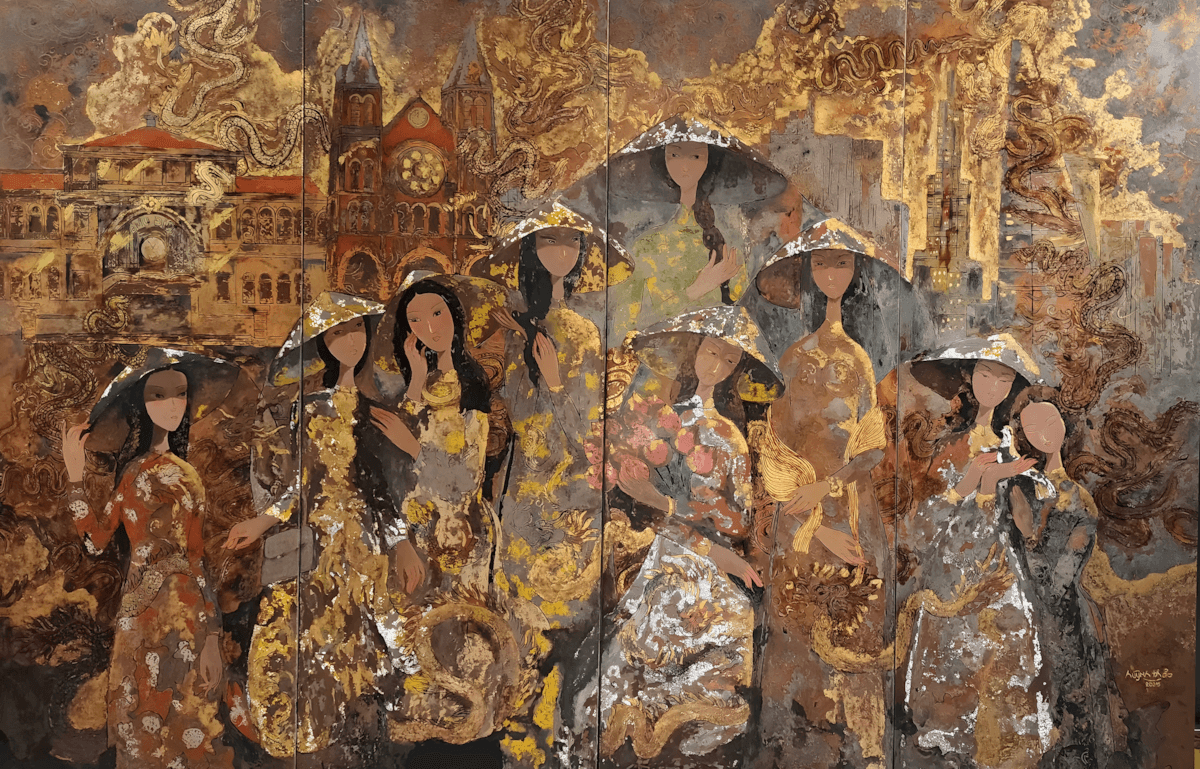
Examine material innovation. Lacquer is especially important because artists transformed a craft material into a modern pictorial medium through experimentation with layering, polishing, color, and composition. Silk painting also developed new relationships between inherited materials and modern exhibition contexts.
Why it remains relevant
The École des Beaux-Arts de l'Indochine offers a useful case study for Giao. It shows that cultural contact produces neither pure continuity nor clean fusion. It produces a field of decisions. Artists decide what to keep, what to transform, what to resist, and what new language can emerge from the encounter.
That is a more useful way to read modern Vietnamese art: as a practice of invention shaped by history, not a category that can be explained through a single influence.
Trace later histories. The school's influence continued through war, independence, new institutions, migration, and the art market. Modern Vietnamese art did not stop at graduation. Follow how artists and teaching traditions changed across political periods and diasporic contexts.
A common mistake is calling the school the single beginning. Vietnam already had extensive artistic and craft traditions. The school reorganized education and professional practice, but it did not create Vietnamese art from nothing.
A common mistake is using synthesis as a neutral term. Cultural synthesis occurred inside unequal power relations. The concept should be examined rather than automatically celebrated.
Look at medium as well as subject
The school is often discussed through its artists and their images. Medium is equally important. Silk painting, lacquer, oil, drawing, and printmaking each bring different histories of craft, labor, surface, and circulation. When artists adapted or transformed these mediums, they were not only choosing a look. They were deciding how a modern work could relate to existing material practices.
For viewers today, this suggests a slower way of looking. Notice what a work is made of, how it handles space, what visual traditions it cites or resists, and how it positions the viewer. Modern Vietnamese art is not a fixed bridge between two simple categories. It is a field shaped by ongoing decisions, encounters, and contradictions.
The École des Beaux-Arts de l'Indochine matters because it concentrated questions that continued to shape Vietnamese modern art: education, colonial power, medium, national identity, and international circulation. A careful reading holds institutional inequality and artistic experimentation together instead of allowing one to erase the other.
A practical way to carry the article forward is to study the colonial structure, follow individual artists, examine material innovation, and trace later histories. The evidence should appear in the sources, named artists, material analysis, historical context, and the limits placed on interpretation.
Further reading
Musée Cernuschi: Vietnamese modern and contemporary art · Vietnam National Fine Arts Museum
Before finalizing the decision, check for two risks: calling the school the single beginning and using synthesis as a neutral term. A final review should separate documented history from inference and leave room for artists, audiences, and communities who may read the same material differently.
Continue reading Meet artists presented through Giao.Artists and Vietnamese Contemporary Art: Materials, Memory, and Modern Life .